

Tissue culture is one of the most powerful techniques in modern plant biotechnology. It allows the rapid multiplication of plants under controlled,
sterile laboratory conditions using small plant tissues or cells. This method is widely used in agriculture, horticulture, forestry, and
commercial plant production because it enables large-scale, disease-free, and genetically uniform plant propagation.
In this blog, we will explore what tissue culture is, how it works, its applications, advantages, limitations, and the role of controlled environment
systems such as LED lighting in successful plant tissue culture.
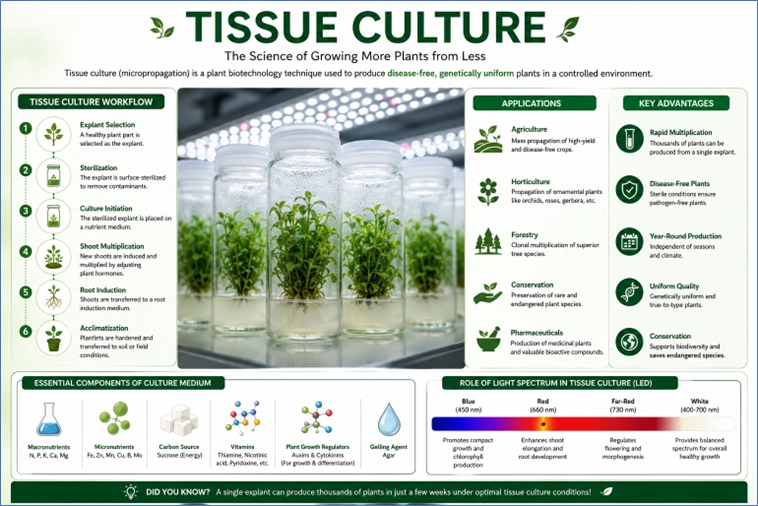
Plant tissue culture (also known as micro propagation) is a technique where small parts of a plant—such as cells, tissues,
or organs—are grown in a nutrient-rich sterile medium under controlled environmental conditions.
These small plant parts, called explants, are capable of developing into complete plants when provided with the right nutrients, hormones, temperature, and light conditions.
Tissue culture is based on the scientific principle of tot potency, which means that every plant cell has the potential to regenerate into a full plant.
Tissue culture involves a series of carefully controlled steps:
1. Selection of Explant
A healthy mother plant is selected, and a small tissue sample (leaf, stem, meristem, or node) is taken.
2. Sterilization
The explant is surface-sterilized using disinfectants to remove bacteria, fungi, and other contaminants.
3. Culture Initiation
The sterilized explant is placed on a nutrient medium (commonly Murashige and Skoog medium – MS medium) containing:
• Macronutrients (N, P, K, Ca, Mg)
• Micronutrients (Fe, Zn, Mn, etc.)
• Sugars (energy source)
• Vitamins
• Plant growth regulators (auxins & cytokinins)
4. Callus Formation / Multiplication
Cells begin to divide and form a mass of undifferentiated cells called callus or directly produce shoots depending on hormone balance.
5. Shoot and Root Development
• By adjusting plant hormones:
• Cytokinins promote shoot formation
• Auxins promote root formation
6. Acclimatization (Hardening)
The plantlets are transferred from sterile lab conditions to greenhouse environments for gradual adaptation before field transplantation.
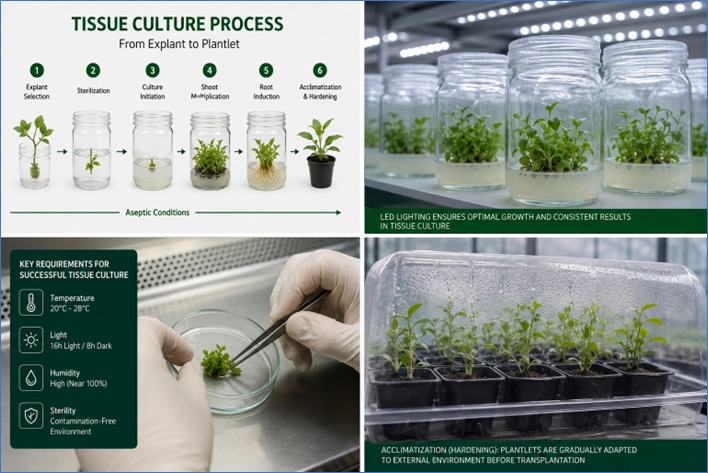
Successful tissue culture depends heavily on controlled environmental parameters:
1. Temperature
Most plant cultures require 20°C to 28°C for optimal growth.
2. Light
Light plays a crucial role in morphogenesis (plant development). Typically:
• 16 hours light / 8 hours dark photoperiod
Controlled light intensity (low to moderate)
3. Humidity
• High humidity is maintained inside culture vessels, often near 100%.
4. Sterility
Even a small contamination can destroy entire cultures, so aseptic conditions are essential.
Light is not just for photosynthesis—it also regulates plant hormones, growth patterns, and morphogenesis.
In tissue culture labs, artificial lighting systems are preferred over sunlight because they offer:
• Stable intensity
• Controlled spectrum
• Low heat emission
• Consistent photoperiod
Modern plant tissue culture increasingly relies on LED grow lights because they allow precise control over light spectrum.
Key benefits include:
• Red light (660 nm): promotes root and shoot elongation
• Blue light (450 nm): enhances chlorophyll production and compact growth
• Far-red light (730 nm): influences flowering and plant morphology
• Low heat output: prevents tissue dehydration
• Energy efficiency: reduces operational cost
Controlled spectrum lighting improves:
• Shoot multiplication rate
• Plantlet quality
• Rooting efficiency
• Survival rate during acclimatization
Tissue culture is widely used across multiple industries:
1. Agriculture
• Rapid multiplication of high-yield crops
• Production of disease-free planting material
2. Horticulture
• Propagation of ornamental plants like orchids, gerbera, carnation, and roses
3. Forestry3. Forestry
• Mass production of superior tree species
4. Conservation
• Preservation of endangered plant species
5. Industrial Production
• Production of medicinal plants and bioactive compounds
Tissue culture offers several significant benefits:
1. Rapid Plant Multiplication
Thousands of plants can be produced from a single explant in a short time.
2. Disease-Free Plants
Sterile conditions eliminate pathogens.
3. Year-Round Production
Independent of seasonal limitations.
4. Uniform Quality
All plants are genetically identical (clonal propagation).
5. Conservation of Rare Species
Helps protect endangered plants from extinction.
Despite its advantages, tissue culture also has challenges:
1. High Initial Setup Cost
Requires lab equipment, sterile environment, and skilled technicians.
2. Contamination Risk
Fungal or bacterial contamination can destroy cultures quickly.
3. Somaclonal Variation
Genetic variations may occur in some cases.
4. Acclimatization Losses
Many plantlets fail during transfer from lab to soil if not hardened properly.
The success of tissue culture is increasingly dependent on environmental precision, especially lighting. This is where advanced LED grow light systems play a transformative role.
Companies like Fluortronix are contributing to this field by developing specialized LED grow light solutions designed for plant science applications, including tissue culture labs,
vertical farming systems, and controlled environment agriculture.
These systems help researchers and growers maintain:
• Stable light spectra for consistent plant development
• Improved shoot multiplication rates
• Better rooting performance
• Reduced energy consumption compared to traditional lighting
With controlled spectrum technology, tissue culture laboratories can significantly improve efficiency and plant quality.
The future of tissue culture is closely linked with automation, AI-based monitoring, and precision agriculture technologies. Emerging trends include:
These systems help researchers and growers maintain:
• Automated bioreactors for mass propagation
• AI-controlled growth monitoring systems
• Smart LED lighting with dynamic spectrum control
• Integration with vertical farming systems
Tissue culture is a revolutionary plant propagation technique that has transformed modern agriculture and horticulture. By
enabling rapid, disease-free, and large-scale plant production, it supports food security, commercial farming, and biodiversity conservation.
When combined with controlled environment technologies like LED grow lights, tissue culture becomes even more efficient and scalable. With advancements in lighting, automation,
and plant biotechnology, the future of tissue culture is highly promising.